
How to Tell If an Affiliate Product Is Legit
How to Tell If an Affiliate Product Is Legit Before You Promote It
How to tell if an affiliate product is legit before you promote it is simple: stop treating commissions as proof. A big payout does not mean the offer is safe.
You can build the perfect funnel.
You can write the perfect review.
You can drive the perfect traffic.
But if the product is bad, none of it matters.
You do not just lose a commission.
You lose trust.
And trust is the only asset that compounds in affiliate marketing.
Why Affiliates Must Check Product Legitimacy First
Let’s start with the opposing view.
A lot of affiliates believe this:
“My job is to send traffic. The vendor handles the product.”
That sounds practical.
It also sounds fair.
You are not the product creator.
You did not build the checkout page.
You did not write the refund policy.
You did not train the support team.
So why should you be responsible for all of that?
Your role seems simple.
Find an offer.
Create content.
Send clicks.
Earn commissions.
That is the clean version of affiliate marketing.
And for a while, it can feel true.
Especially when you are new.
You see other people promoting everything.
You see income screenshots.
You see leaderboards.
You see people pushing tools, courses, supplements, software, and services.
Nobody seems to be asking deep questions.
So you wonder why you should.
If everyone else promotes fast, why slow down?
If the vendor has a sales page, why inspect it?
If the affiliate network approved the offer, why worry?
If the commission is high, why hesitate?
That is the mindset.
It feels efficient.
But when you follow that logic all the way through, it collapses.
How to Know If an Affiliate Product Is Legit
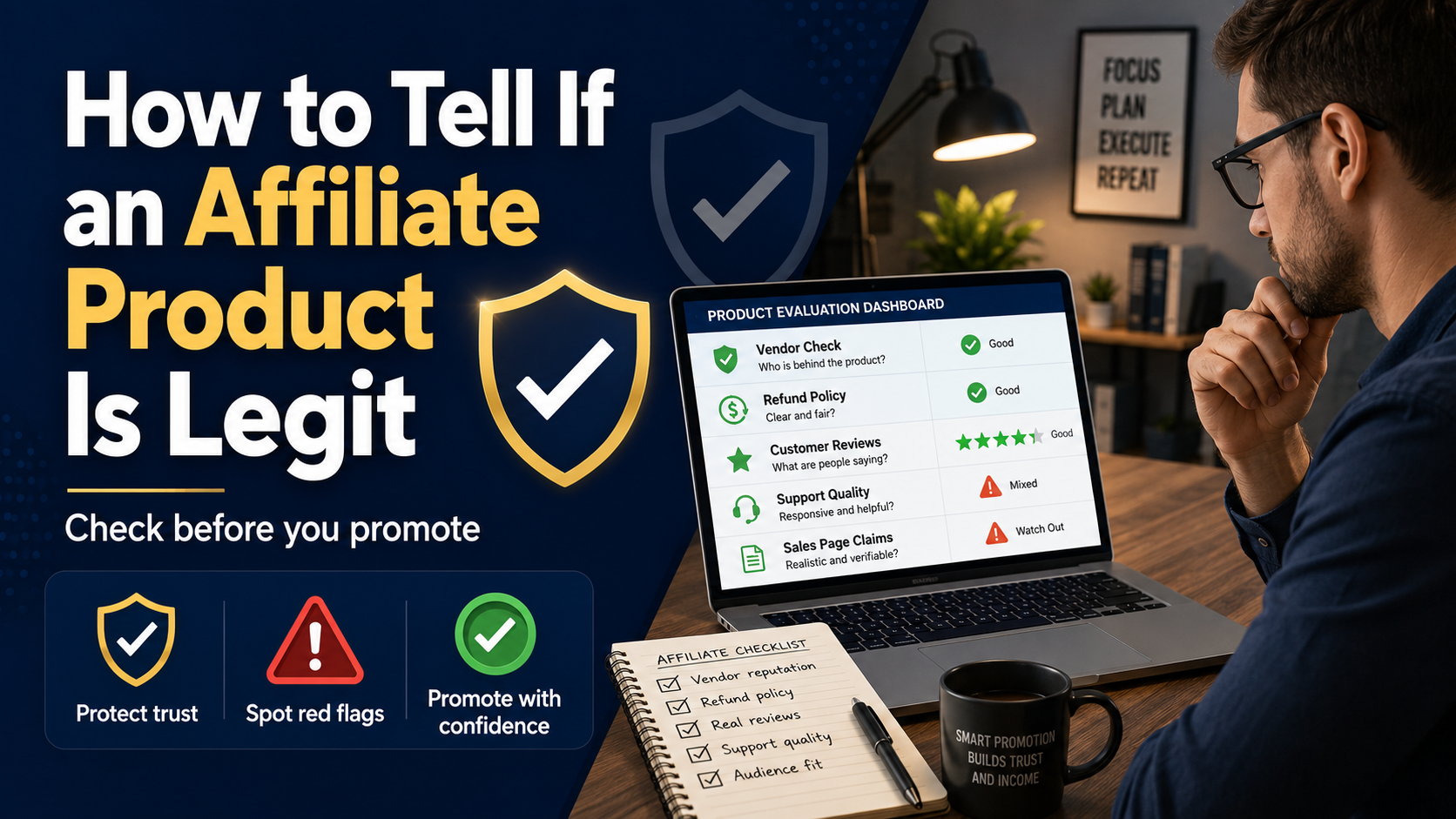
To know if an affiliate product is legit, check the vendor, refund policy, customer reviews, sales page claims, support quality, payout reliability, and full buyer experience. A legitimate offer solves a real problem, sets realistic expectations, supports customers, and protects your reputation when you recommend it.
Why “Just Send Traffic” Is a Bad Affiliate Strategy
Let’s take the opposing view seriously.
Suppose your only job is traffic.
You do not need to verify the product.
You do not need to test the offer.
You do not need to check reviews.
You do not need to inspect refund complaints.
You only need clicks.
That means your audience is not really your audience.
They are just traffic.
And if they are just traffic, trust does not matter.
But if trust does not matter, your recommendations lose power.
And if your recommendations lose power, your conversions drop.
So the “just send traffic” mindset destroys the thing it needs most.
Affiliate marketing works because people borrow your judgment.
They click because you filtered the noise.
They buy because you reduced uncertainty.
They trust that you looked before pointing.
If you refuse to inspect products, you are not recommending them anymore.
You are forwarding strangers to sales pages.
That is not influence.
That is traffic brokering.
And traffic brokering is a weak business unless you own huge volume.
Most affiliates do not.
Most affiliates survive on trust.
So the opposing view creates a contradiction.
It says product quality is not your problem.
But your income depends on people believing your judgment.
You cannot protect that judgment while refusing to use it.
Why High Affiliate Commissions Need Extra Scrutiny
Now take the next common argument.
“But this product pays 50% commission.”
That sounds tempting.
A high commission feels like proof of opportunity.
But it may prove the opposite.
Sometimes a high commission exists because the offer needs aggressive promotion.
Sometimes the vendor pays more because retention is weak.
Sometimes, the front-end sale looks attractive because refunds are buried later.
Sometimes affiliates get paid well because customers are not stay happy.
A high commission is not a green light.
It is a reason to inspect harder.
If a product pays you $200 per sale, the risk is not smaller.
It is larger.
Your recommendation carries more weight.
Your audience spends more money.
Your reputation takes a bigger hit if the product disappoints.
So the “high commission” argument defeats itself.
The more money you can make from the offer, the more careful you must be.
Otherwise, you are admitting something ugly.
You are saying your audience should take more risks because you get paid more.
That is not a business model.
That is a trust leak.
And trust leaks do not show up immediately.
They show up later.
People stop opening your emails.
They ignore your links.
They question your reviews.
They assume every recommendation has a hidden motive.
At that point, even good offers become harder to sell.
One bad promotion can poison five future ones.
Why Affiliate Network Approval Is Not Enough
Another common defense sounds like this:
“The network approved the offer, so it must be legit.”
That is comforting.
But it is not enough.
An affiliate network is not your audience.
It does not have your positioning.
It does not have your relationship with your readers.
It does not carry your name in the recommendation.
A network may check basic rules.
It may screen for obvious fraud.
It may provide tracking.
It may handle payouts.
But that does not mean the product fits your audience.
It does not mean the claims are fair.
It does not mean support is strong.
It does not mean customers are satisfied.
It does not mean refund rates are healthy.
It does not mean you should attach your credibility to it.
The network’s approval answers one question.
“Can this offer exist on the platform?”
Your question is different.
“Should I recommend this to people who trust me?”
Those are not the same question.
So the network argument collapses too.
It shifts responsibility to someone with different incentives.
The platform wants active offers.
The vendor wants sales.
You want long-term trust.
Those goals can overlap.
But they are not identical.
That is why you must run your own check.
Why Popular Affiliate Offers Can Still Be Risky
Another weak argument is popularity.
You see big affiliates promoting an offer.
So you assume it must be safe.
But popularity does not prove legitimacy.
It proves exposure.
Plenty of bad offers get promoted heavily.
Sometimes they get promoted because the launch is hyped.
Sometimes affiliates copy each other.
Sometimes, everyone sees the commission and rushes in.
Sometimes, nobody wants to ask hard questions before the leaderboard closes.
The crowd can be wrong.
Worse, the crowd can be temporarily rewarded for being wrong.
A product can sell well and still harm buyers.
A product can convert well and still have poor support.
A product can produce huge launch revenue and still create refund waves.
A product can look legitimate from the outside and still fail customers after purchase.
So “everyone is promoting it” is not due diligence.
It is social pressure.
And if you rely on social pressure, your audience no longer gets your judgment.
They get the crowd’s impulse filtered through your brand.
That is dangerous.
Because when the crowd moves on, you remain accountable.
Your reader does not blame “the market.”
They blame you.
You were the person they trusted.
You were the person who said it was worth a look.
Why the Sales Page Is Not Proof of Product Quality
A polished sales page can feel convincing.
It may have testimonials.
It may have screenshots.
It may have logos.
It may have a strong guarantee.
It may have a clean design.
But sales pages are designed to sell.
That does not make them false.
It means they are not neutral.
A sales page is the vendor’s best case.
Your job is to find the truth behind the best case.
Are the testimonials real?
Are the results typical?
Is the guarantee simple?
Are the claims specific?
Does the product match the promise?
Can a normal buyer get the stated result?
What happens when someone needs help?
What happens when someone asks for a refund?
The sales page can start your research.
It cannot finish it.
If you accept the sales page as proof, you are letting the vendor grade itself.
That makes no sense.
Nobody serious would buy a used car after only reading the seller’s description.
Nobody serious would hire someone after only reading their own bio.
Nobody serious would invest based only on a pitch deck.
Yet affiliates do this with products all the time.
Then they act surprised when trust gets damaged.
How to Review the Full Affiliate Buyer Experience
Here is where many affiliates get confused.
They think the product is the course, tool, supplement, app, or service.
That is only part of it.
The real product is the full customer experience.
That includes the promise.
The checkout.
The onboarding.
The delivery.
The support.
The refund process.
The billing clarity.
The follow-up emails.
The upsells.
The actual result.
If any part of that experience is broken, your recommendation suffers.
Your audience does not separate the pieces.
They do not say:
“The affiliate recommended well, but the vendor’s onboarding failed.”
They say:
“I bought it because of you, and it was disappointing.”
That may not feel fair.
But it is real.
A recommendation creates borrowed trust.
When the customer has a bad experience, that trust is lost.
This is why checking legitimacy before promotion is not optional.
It is the cost of making recommendations.
If you want the upside of influence, you must accept the duty of judgment.
How Bad Affiliate Products Damage Trust Over Time
One reason affiliates skip due diligence is simple.
The damage is delayed.
A bad offer may still convert today.
You may still earn commissions this week.
The launch may still look successful.
The numbers may look good in your dashboard.
But later, the cost appears.
Refunds rise.
Support complaints appear.
People reply angrily.
Your list gets colder.
Your future offers convert worse.
Your content feels less trusted.
Your name carries less weight.
That is the trap.
Bad offers often pay before they punish.
This makes them seductive.
You get the reward first.
You feel smart.
Then the hidden cost arrives.
And because the cost is spread out, many affiliates do not connect it to the original mistake.
They blame the algorithm.
They blame the list.
They blame the niche.
They blame “buyer fatigue.”
But sometimes the real problem is simpler.
They trained their audience not to trust them.
That is not an algorithm problem.
That is a recommendation problem.
How to Check an Affiliate Product Without Overthinking
Some affiliates hear this and think:
“So I need to investigate everything forever?”
No.
That is not the point.
You do not need perfect certainty.
You need reasonable confidence.
You need enough proof to say:
“I checked this like a responsible person.”
That means you look for clear signals.
Check the vendor history before you promote.
Review real customer feedback.
Inspect the refund terms.
Test support responsiveness.
Compare claims against realistic outcomes.
Look for complaint patterns.
Examine payout reliability.
Check whether the sales page exaggerates.
See whether the product actually solves the problem it claims to solve.
This does not require months.
It requires a process.
The goal is not to eliminate all risk.
That is impossible.
The goal is to avoid obvious, preventable trust damage.
That is completely possible.
Why Affiliates Need Responsibility Before Promotion
Now follow the opposing view to its conclusion.
If affiliates do not need to check products, then no one in the recommendation chain needs responsibility.
The vendor says:
“Affiliates should know what they promote.”
The affiliate says:
“The vendor should deliver what they sell.”
The network says:
“We only provide the platform.”
The buyer is left alone.
Everyone takes the upside.
Nobody owns the trust.
That system cannot last.
It produces worse recommendations.
It rewards louder claims.
It punishes careful buyers.
It turns affiliate marketing into a race toward hype.
And once audiences feel that, they resist everything.
They stop believing reviews.
They assume every comparison is biased.
They treat every bonus as bait.
They see every link as a trick.
That hurts everyone.
Good affiliates suffer because bad affiliates have trained the market to doubt them.
Good vendors suffer because buyers become skeptical.
Good products suffer because hype polluted the channel.
So even from a selfish view, verification protects the market you depend on.
How Product Verification Becomes an Affiliate Advantage
Most affiliates are lazy.
That sounds harsh.
But it is true.
They copy sales page claims.
They rewrite vendor bullets.
They publish shallow reviews.
They chase commissions.
They promote whatever launches.
That creates your opening.
A careful legitimacy check makes your content different.
You can say things others cannot say.
You can explain what you checked.
You can show where the product is strong.
You can name who it is not for.
You can disclose risks.
You can compare claims against real use.
You can recommend with confidence.
That makes your content more believable.
And believable content converts.
Not because it screams louder.
Because it reduces doubt.
People do not need more hype.
They need a reason to feel safe.
A legitimacy check gives them that reason.
It turns your review from a sales pitch into a filter.
And filters are valuable.
Why Audience Trust Is the Real Affiliate Asset
People may forget the exact offer.
They may forget the headline.
They may forget the bonus.
But they remember how your recommendation made them feel afterward.
Did they feel smarter?
Did they feel protected?
Did they feel respected?
Did they feel warned about real tradeoffs?
Did they feel you cared about their outcome?
Or did they feel pushed?
Did they feel used?
Did they feel like your commission mattered more than their result?
That emotional memory becomes your brand.
Affiliate marketing is not just link placement.
It is a repeated trust transfer.
Each recommendation teaches your audience what your word is worth.
A legit product strengthens that word.
A bad product weakens it.
Enough good recommendations create authority.
Enough careless ones create suspicion.
That is the whole game.
How to Promote Legit Affiliate Products Long Term
The opposing view began with a simple claim.
“My job is only to send traffic.”
But that claim cannot survive contact with reality.
If your audience is just traffic, your trust disappears.
If trust disappears, your recommendations lose power.
If your recommendations lose power, your commissions shrink.
If commissions shrink, the strategy fails.
So the traffic-only mindset destroys itself.
The only durable position is this:
An affiliate must check whether a product is legit before promoting it.
Not because affiliates control everything.
They do not.
Not because every product must be perfect.
It will not be.
Not because risk can vanish.
It cannot.
But because recommendations carry responsibility.
And responsibility is what makes recommendations valuable.
When you verify before you promote, you protect your audience.
You protect your reputation.
You protect your future conversions.
You protect the trust that makes affiliate marketing work at all.
Promote blind, and you become another link in the noise. Learn how to tell if an affiliate product is legit before you promote it, then only recommend offers you would defend with your name attached.


1 comment