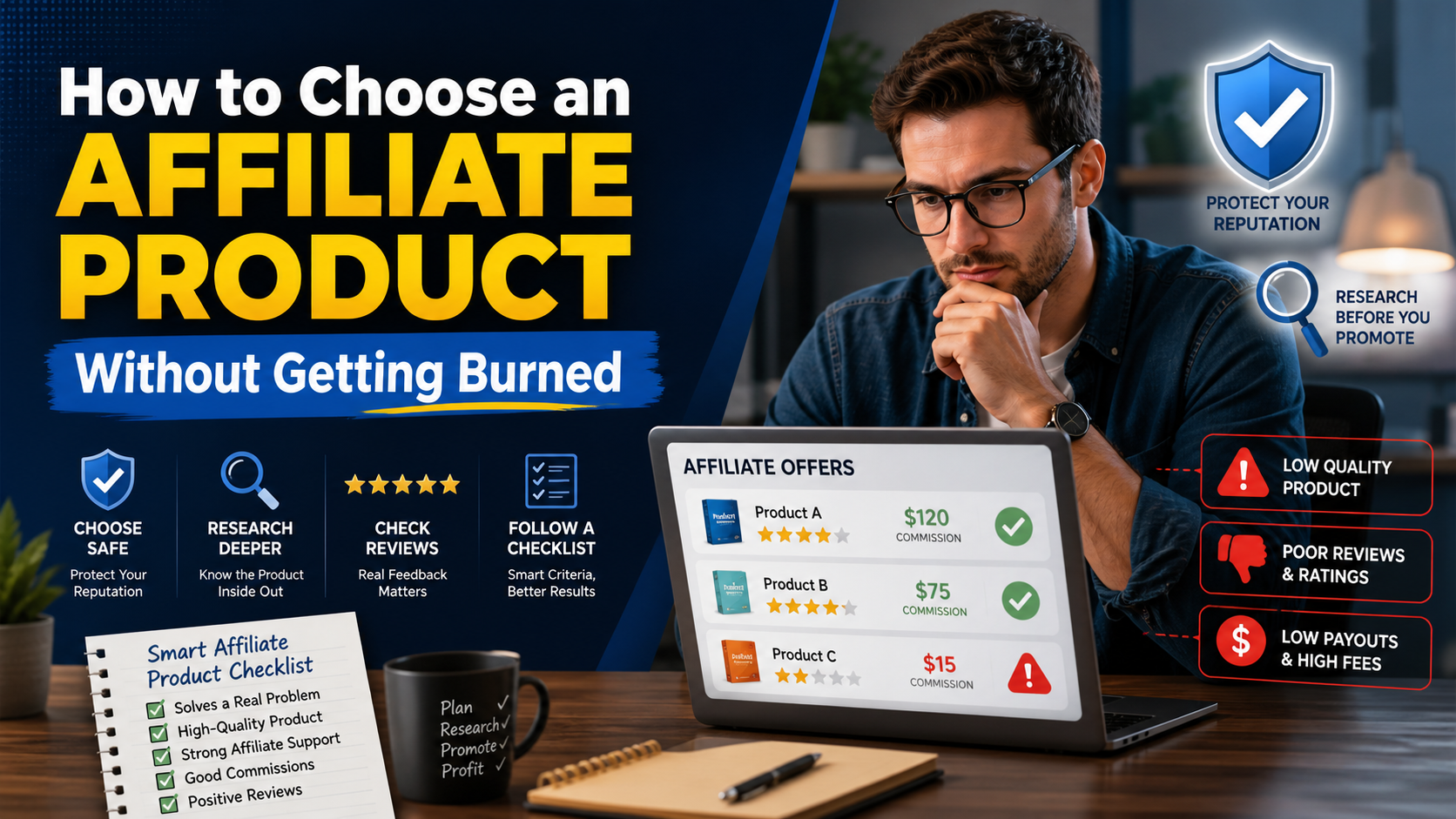
How to Choose an Affiliate Product Without Getting Burned
Learn how to choose a safe affiliate product, avoid bad offers, spot red flags, check vendors, review upsells, and protect your reputation before promoting.
Suggested URL Slug
How to choose an affiliate product without getting burned
Affiliate marketer reviewing product offers with a checklist, ratings, trust icons, and warning signs before choosing a product to promote.
Choosing the wrong affiliate product can cost you more than commissions. It can damage your reputation, waste your time, hurt your audience’s trust, and leave you promoting something you would never recommend if you had properly checked it first.
The good news is this: you do not need to guess.
A smart affiliate marketer does not choose products based only on commission size, hype, or a flashy sales page. A smart affiliate marketer chooses products using a simple checklist that looks at product quality, customer value, sales page honesty, refund risk, support, and long-term trust.
In this guide, you will learn how to choose an affiliate product without getting burned.
Quick Answer
To choose an affiliate product safely, look for a product that solves a real problem, has a trustworthy sales page, offers fair pricing, provides strong customer support, has reasonable commissions, and does not rely on misleading hype or aggressive upsells.
Before promoting anything, check the product, the vendor, the refund policy, the reviews, and the full customer journey.
Your reputation is worth more than one commission.
Why Choosing the Right Affiliate Product Matters
Affiliate marketing is built on trust.
When someone clicks your link, they are not just trusting the product owner. They are trusting you.
If the product is poor, overpriced, misleading, or packed with hidden upsells, your audience may blame you for recommending it. Even if you did not create the product, your name is connected to the recommendation.
That is why beginners should be careful with products that promise quick money, miracle results, or effortless success.
A bad affiliate product can lead to lost trust, refund complaints, low conversions, high refund rates, negative comments, poor repeat sales, damage to your brand, and wasted time creating content.
A good affiliate product can do the opposite. It can help your audience, build authority, create repeat buyers, and give you confidence when you promote it.
The Biggest Mistake Beginners Make
The biggest mistake beginners make is choosing a product only because it pays a high commission.
A 500 dollar commission sounds exciting, but if the product is poor, the refund rate is high, or the sales page makes unrealistic claims, it may not be worth promoting.
A smaller commission from a quality product can be far better than a large commission from a risky one.
Ask yourself this before promoting anything.
Would I feel comfortable recommending this product to a friend?
If the answer is no, do not promote it.
Step 1: Check If the Product Solves a Real Problem
The best affiliate products solve a clear problem.
People buy products because they want a result. They want to save time, make money, lose weight, fix pain, improve skills, reduce stress, grow a business, or avoid a mistake.
Before choosing a product, ask these questions.
What problem does this product solve?
Who exactly is it for?
Is the problem urgent enough for people to pay?
Does the product offer a realistic solution?
Can I explain the benefit clearly in one sentence?
If you cannot clearly explain what the product does, your audience probably will not understand it either.
A strong product has a simple promise.
Example:
This tool helps beginners build affiliate landing pages faster.
That is much better than:
This revolutionary system unlocks hidden income streams using secret digital leverage.
Clear beats clever.
Step 2: Review the Sales Page Carefully
The sales page tells you a lot about the product owner.
A good sales page should explain what the product does, who it is for, what is included, how it works, and what buyers should realistically expect.
Watch out for sales pages that rely too heavily on hype.
Red flags include unrealistic income claims, fake urgency, no clear product explanation, too many vague promises, no proof of what is inside, over-the-top lifestyle images, no mention of work or effort, hidden pricing details, aggressive countdown timers, and no visible refund policy.
A good sales page should make you feel informed, not pressured.
If the sales page feels misleading to you, it may feel misleading to your audience too.
Step 3: Check the Product Creator or Vendor
Before promoting a product, research the person or company behind it.
Look for their name, website, past products, customer feedback, refund history, support reputation, social media presence, training quality, and how long they have been active.
A vendor with a strong history of helping customers is usually safer than a vendor who appears only during big product launches and disappears afterwards.
Search their name with words like review, refund, complaint, scam, support, and customer experience.
Do not panic if you find one or two negative comments. Every business gets complaints. But if you see repeated patterns of poor support, hidden upsells, broken software, or refund issues, be careful.
Step 4: Look at the Full Funnel
Many beginners only look at the front-end product.
That is a mistake.
You need to know what happens after the customer buys.
Check the front-end price, order bump, upsells, downsells, subscription offers, hidden costs, training limitations, upgrade pressure, and refund policy on each offer.
Some products advertise a cheap entry price but rely on multiple upsells to unlock the real value.
Upsells are not automatically bad. Many legitimate businesses use them. The problem is when the front-end product feels incomplete without buying more.
Ask this question.
Can the buyer get real value from the front-end product alone?
If the answer is no, be cautious.
Step 5: Check the Refund Policy
A clear refund policy protects both the buyer and your reputation.
Before promoting a product, check how long the refund period is, whether it is no questions asked or conditional, whether there are exceptions, whether it applies to upsells, who handles support, and whether the refund policy is easy to find.
If the refund policy is hidden, confusing, or very restrictive, that is a warning sign.
A product with a fair refund policy usually shows more confidence in what it sells.
Step 6: Look for Real Reviews
Do not rely only on testimonials shown on the sales page.
Look for independent reviews, YouTube videos, blog posts, marketplace ratings, Facebook group comments, Reddit discussions, and customer feedback.
When reading reviews, look for patterns.
Good signs include customers saying the product delivered what was promised, support responded quickly, the training was clear, the software worked as expected, the product helped solve a specific problem, and buyers felt the price was fair.
Bad signs include repeated refund complaints, software not working, training that was too basic, support not replying, customers feeling misled, the product requiring extra purchases to be useful, and reviews that sound copied or fake.
One review does not tell the whole story. Patterns do.
Step 7: Check Product Quality Yourself
The best way to avoid getting burned is to inspect the product yourself.
If possible, buy it or request review access.
Look at dashboard quality, training depth, ease of use, download links, support area, bonuses, updates, community access, customer onboarding, mobile usability, instructions, and tutorials.
Ask yourself these questions.
Would a beginner understand this?
Does the product match the sales page?
Is the content useful or just filler?
Does the product feel complete?
Would I be happy if I paid for this?
If you would be disappointed as a buyer, do not promote it as an affiliate.
Step 8: Check Commission and Conversion Potential
Commission matters, but it should not be the only factor.
Look at commission percentage, average order value, cookie duration, marketplace reputation, conversion rate if shown, refund rate if shown, recurring commission potential, payout reliability, payment method, and affiliate terms.
A product with a lower commission but strong customer satisfaction can be better than a high-ticket offer with lots of refunds.
You want a product that converts well and keeps customers happy.
Step 9: Match the Product to Your Audience
Even a good product can be wrong for your audience.
Ask yourself these questions.
Is this product suitable for beginners?
Does it match my niche?
Does it fit my audience’s budget?
Does it solve a problem my audience already has?
Can I create helpful content around it?
Will my audience trust this recommendation?
For example, if your audience is beginners in affiliate marketing, promoting an advanced automation tool may not be the best first recommendation.
Start with products that match their current stage.
Beginner audience: simple tools, training, checklists, and starter systems.
Intermediate audience: traffic tools, funnel builders, and email marketing systems.
Advanced audience: automation, analytics, scaling systems, and high-ticket coaching.
The better the match, the easier the sale.
Step 10: Avoid Products That Make You Feel Uneasy
Sometimes the numbers look good, but something feels off.
Trust that feeling.
Be cautious if the sales page feels too aggressive, the income claims seem unrealistic, the vendor hides important details, the product has too many upsells, the refund policy is unclear, the product owner has a poor reputation, you cannot explain what the product actually does, or the product seems designed more for affiliates than customers.
A product should help the customer first. If it only seems designed to make affiliates money, be careful.
Affiliate Product Safety Checklist
Before promoting any affiliate product, go through this checklist.
The product solves a real problem.
The sales page is clear and honest.
The product owner has a reasonable reputation.
The front-end product has real value.
The upsells are optional, not essential.
The refund policy is clear.
The product has positive independent feedback.
The commission is fair.
The product matches your audience.
You would feel comfortable recommending it publicly.
If a product fails several of these checks, move on.
There will always be another product to promote.
Green Flags to Look For
A good affiliate product usually has a clear promise, fair pricing, real customer value, a transparent sales page, helpful support, positive user feedback, reasonable refund terms, useful training or onboarding, strong product market fit, and a vendor with a visible reputation.
These are the products that help you build long-term trust.
Red Flags to Avoid
Be careful with products that have hidden upsells, fake scarcity, overhyped income claims, no clear refund policy, poor support reputation, low-quality training, no real screenshots, vague product explanation, too many complaints, or no visible vendor history.
The more red flags you see, the more careful you should be.
A Simple Scoring System
You can use this simple score before promoting a product.
Rate each section from 1 to 5.
Product quality.
Sales page honesty.
Vendor reputation.
Customer support.
Refund policy.
Audience fit.
Commission value.
Upsell transparency.
Beginner friendliness.
Long-term trust.
Total score out of 50.
Suggested verdict:
45 to 50: Excellent product to consider promoting.
38 to 44: Good product, but review carefully.
30 to 37: Risky, promote only with caution.
Below 30: Avoid.
This type of scoring system helps you make decisions based on evidence, not emotion.
Example Verdict
Let’s say you find a product with a 100 dollar commission.
At first, it looks attractive.
But after checking it, you discover the sales page makes unrealistic income claims, the front-end product is very basic, there are five upsells, the refund policy is hard to find, and the vendor has multiple support complaints.
Even though the commission is high, this is probably not a product you should promote.
Now compare that with a product paying 35 dollars per sale.
It has clear training, good reviews, fair pricing, responsive support, a transparent sales page, no aggressive upsell pressure, and real value for beginners.
That second product may be the better long-term choice.
Best Types of Affiliate Products for Beginners to Promote
Beginners should usually start with products that are easier to explain and easier to trust.
Good options include simple software tools, beginner courses, templates, checklists, website tools, email marketing tools, content creation tools, productivity tools, low-cost training products, and recurring subscription tools with good support.
Avoid starting with products that are confusing, overly technical, extremely expensive, or based on unrealistic promises.
Final Verdict
Choosing an affiliate product is not about chasing the highest commission. It is about protecting your audience, your brand, and your long-term income.
The best affiliate products are clear, useful, honest, fairly priced, and suitable for your audience.
Before you promote anything, research the product, inspect the sales page, check the vendor, understand the funnel, review the refund policy, and ask one important question.
Would I still recommend this product if there were no commission?
If the answer is yes, you may have found a product worth promoting.
FAQ
What makes a good affiliate product?
A good affiliate product solves a real problem, provides genuine value, has a clear sales page, offers fair pricing, and gives buyers a good customer experience.
Should I promote products with upsells?
You can promote products with upsells, but only if the front-end product delivers real value by itself. If the customer must buy the upsells to get the promised result, be careful.
Is a high commission always better?
No. A high commission is not always better. A lower commission from a trustworthy product can be more valuable than a high commission from a product with high refund rates or poor customer satisfaction.
How do I know if an affiliate product is risky?
Look for red flags such as unrealistic claims, hidden costs, poor reviews, unclear refund terms, aggressive upsells, and a vendor with a weak reputation.
Should I buy the product before promoting it?
Ideally, yes. Buying or testing the product gives you firsthand experience and helps you create a more honest review. If you cannot buy it, try to get review access or research independent customer feedback.
What is the safest product for beginners to promote?
The safest products are usually simple, affordable, easy to explain, and genuinely useful to your audience. Tools, templates, beginner training, and low-risk software subscriptions can be good starting points.